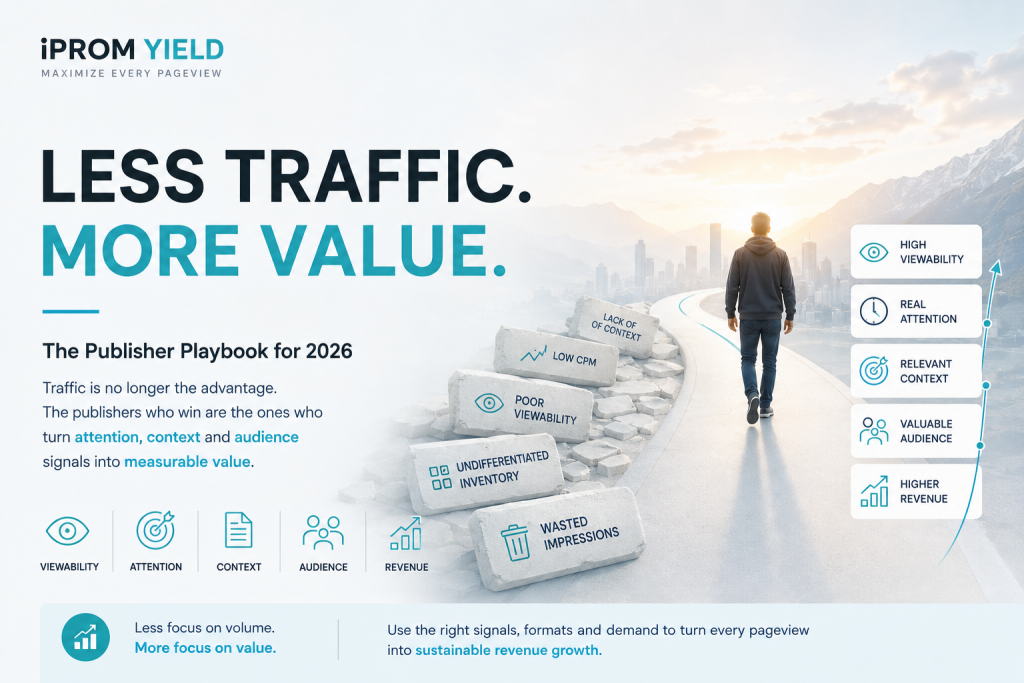
For years, digital publishing followed a relatively simple equation:
More traffic → more impressions → more advertising revenue.
In 2026, that equation is becoming much less reliable.
Search behavior is changing. AI-generated answers are competing for clicks that previously went directly to publishers. Social platforms increasingly keep users inside their own ecosystems. At the same time, the supply of digital advertising inventory continues to grow.
For publishers, this creates an uncomfortable reality:
Traffic can no longer be the primary monetization strategy.
The next phase of publisher monetization will be about generating more value from the audience you already have.
And that changes how we should think about yield optimization.
An impression is no longer just an impression
Programmatic advertising has spent years optimizing how efficiently impressions are bought and sold.
But not all impressions create the same value.
Consider two impressions generated on the same website.
One appears below the fold, is technically viewable for a fraction of a second and competes with several other advertising units.
Another appears naturally within content, remains visible while the user is actively reading and is surrounded by highly relevant editorial context.
Technically, both are impressions.
Commercially, they are completely different products.
This distinction is becoming increasingly important.
Advertisers are becoming more selective about the environments, audiences and inventory they buy. Publishers therefore need to become equally sophisticated about the inventory they sell.
Stop optimizing for impressions alone
One of the easiest mistakes in publisher monetization is maximizing the number of advertising opportunities instead of maximizing their value.
Adding another placement creates more inventory.
But more inventory does not automatically create more revenue.
Sometimes removing or repositioning an ad can actually increase total revenue.
This is why we increasingly look beyond simple CPM and impression numbers when optimizing publisher inventory.
The better question is:
How much revenue does each pageview generate?
Revenue per pageview changes the conversation
Imagine Publisher A generates five advertising impressions per pageview at an average €0.80 eCPM.
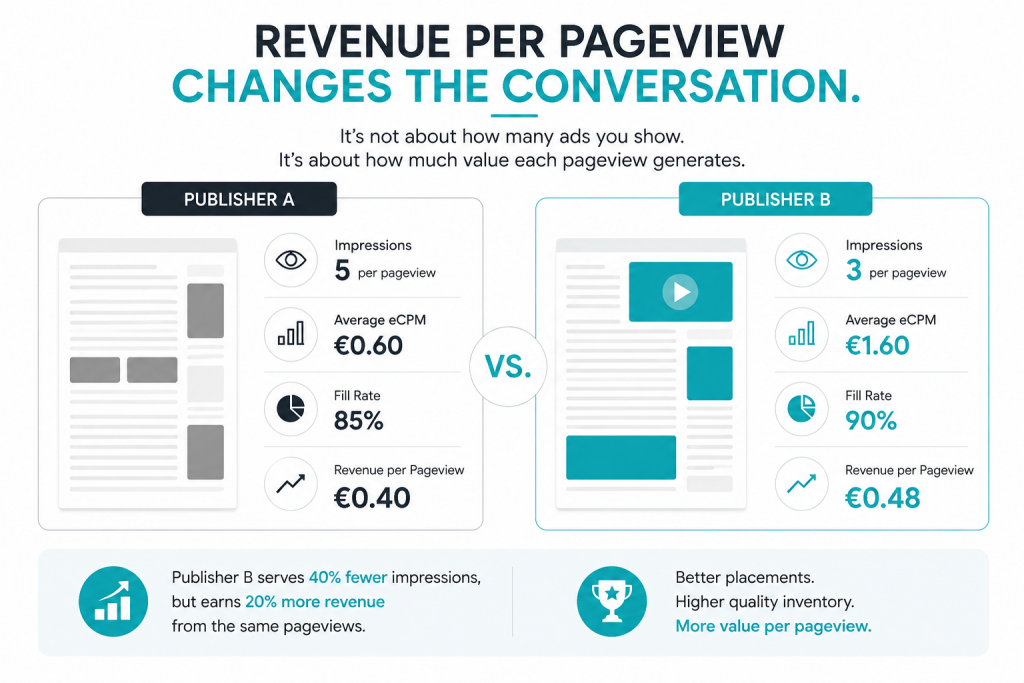
Publisher B generates three impressions at €1.60 eCPM.
Publisher B serves 40% fewer ads but generates more advertising revenue from the same amount of traffic.
That is yield optimization.
The objective should not necessarily be maximizing ad calls or impressions.
The objective is maximizing sustainable revenue from every user session.
And to do that, publishers need to understand several layers simultaneously.
1. Viewability
Viewability remains one of the clearest signals separating valuable inventory from commodity inventory.
Placement position, lazy loading, page layout, refresh logic and user behavior all influence whether an impression actually has an opportunity to be seen.
A placement with consistently strong viewability becomes more attractive to demand partners.
A placement generating millions of impressions with poor viewability may simply be creating large volumes of low-value supply.
This is why viewability should not only be treated as a reporting metric.
It should be treated as a yield signal.
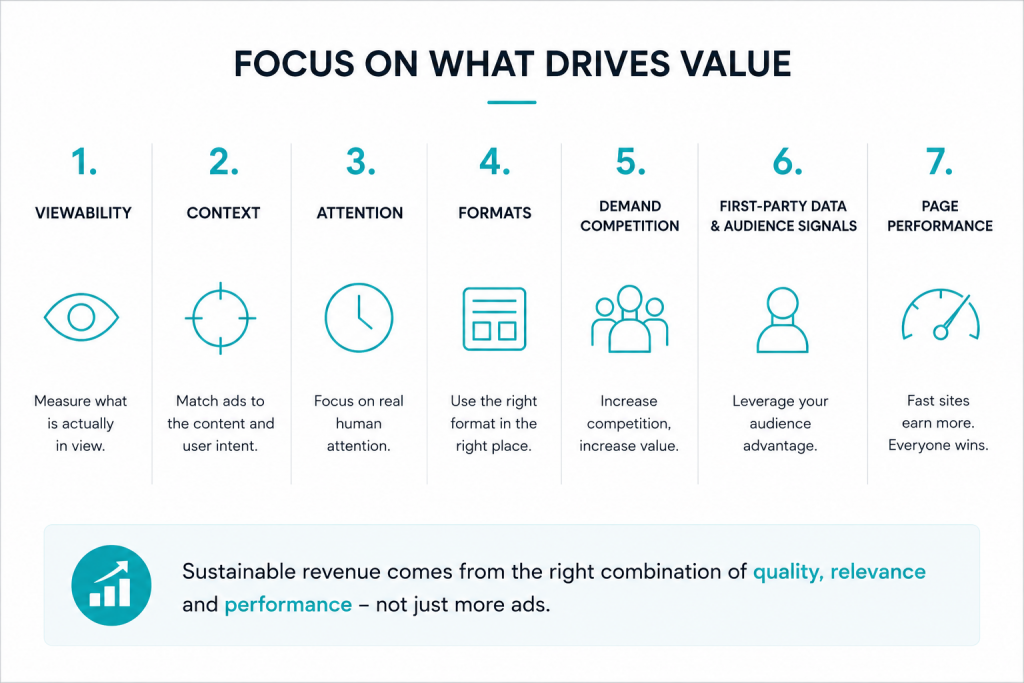
2. Context
Publishers already own something extremely valuable: content.
Every article contains information about the interests and intent of the person reading it.
A user reading automotive reviews is providing a different commercial signal from someone reading financial news, travel content or home renovation advice.
Publishers do not necessarily need additional personal information to create value from these signals.
They need the technology to structure them and make them usable within the advertising ecosystem.
In a privacy-first environment, editorial context is becoming a monetization asset again.
3. Attention
Viewability tells us whether an advertisement had the opportunity to be seen.
Attention goes one step further.
How long was the placement visible? Was the user actively consuming the page? Was the advertisement positioned inside the natural reading flow? Was it competing with several other units for the same user’s attention?
These questions will increasingly influence how premium inventory is defined.
Publishers who understand attention patterns across their pages can design advertising environments around actual user behavior instead of simply filling available space with ads.
4. Formats
Format strategy matters as much as placement strategy.
Standard display will remain an important part of publisher monetization, but it should not be the only tool available.
Video, native, rich media, sticky formats and other high-impact units can unlock demand that standard display inventory cannot access.
The important point is not to deploy every possible format.
It is to use the right format in the right environment.
A high-impact format with excellent viewability and strong user engagement can generate significantly more value than several low-performing standard placements.
5. Demand competition
Even excellent inventory cannot achieve its full value without sufficient demand competition.
This remains one of the fundamental principles of programmatic monetization.
Publishers should continuously evaluate which SSPs are actually bidding, how frequently they participate, their win rates, their contribution to incremental revenue, performance by GEO and device, timeout behavior, and whether additional demand creates real competition or simply additional technical overhead.
More bidders do not automatically mean better monetization.
The goal is the right demand mix.
6. First-party data and audience signals
Publishers also have a strategic advantage that is often underutilized.
They have direct relationships with their audiences.
Newsletter subscriptions, registrations, content preferences, returning-user behavior and other first-party signals can help publishers better understand and package their audiences.
As third-party identifiers become less reliable, this direct relationship becomes increasingly important.
The publishers who can combine quality content, context and responsible first-party data activation will have a much stronger position in the advertising ecosystem.
7. Page performance
There is another part of yield optimization that is easy to underestimate: technical performance.
Every additional script has a cost. Every bidder adds latency. Every poorly implemented advertising unit can affect page performance. Every consent problem can reduce addressable demand.
And every small technical inefficiency becomes significant when multiplied across millions or billions of ad requests.
Modern yield optimization therefore sits somewhere between advertising, data science and engineering.
The publisher monetization audit
If I were auditing a publisher today, I would start with ten questions:
- Which placements actually generate the most revenue per pageview?
- What is the viewability of each major placement?
- Are we creating too many low-value impressions?
- Which demand partners generate truly incremental revenue?
- Are contextual signals being passed correctly?
- Are we making effective use of first-party data?
- Which formats generate the highest value without damaging UX?
- Is latency reducing auction participation or impression delivery?
- Are consent and privacy signals reaching every platform correctly?
- How much revenue are we generating from each user session?
From traffic optimization to value optimization
The open web is changing.
Publishers may have less control over how much traffic search engines, social networks and AI platforms send to them.
But they still have considerable control over what happens when a user arrives.
They control the content. They control the page environment. They control the advertising formats. They control their technology stack. They control which demand sources compete for their inventory. And increasingly, they control the data and signals that describe the value of their audience.
That is why I believe the next stage of publisher monetization will not be defined by who generates the most impressions.
It will be defined by who creates the most value from them.
Less focus on volume. More focus on value.
That is where the next generation of yield optimization begins.